
The Only Magazine for Children's Art
Sep 1, 2026
The Whitney honors her with a posthumous solo exhibit.
Perhaps it says something about the incredible power of creativity to sustain our vitality. Japanese artist Yayoi Kusama, who passed away this week at age 97, was the recipient of an almost inconceivable surge in global recognition in the last dozen or so years of her life, when her immersive 'Infinity Mirror Rooms' became a worldwide sensation. Yoko Ono, still working at 93, is right now enjoying her first ever Los Angeles solo exhibition at The Broad.
Perhaps even more incredible, Aboriginal artist Sally Gabori found her life so radically changed when, at 81, she began painting vibrant abstractions that won her almost immediate international acclaim. As we wrote about in a recent tigernoodles story timed to her posthumous exhibit at LA's Karma gallery, her work would go on to be featured in the Venice Biennale, as well as Paris' prestigious Fondation Cartier, before she passed in 2015, at age 91.
The story of Minnie Evans (born 1892) is particularly poignant, that of an African American artist who took up painting when she was already in her 50's - and despite the not insignifant odds against her, ultimately went on to be honored with a solo exhibition at New York's Whitney Museum of American Art in 1975. She was the first Black woman ever to be given that considerable distinction.

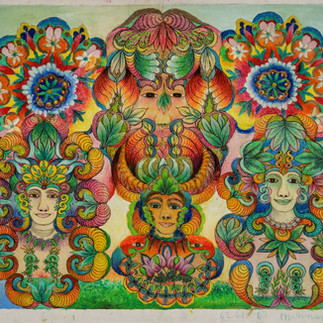


Five decades later - she died of natural causes in 1987 at 95 - the Whitney is honoring her memory and legacy by again staging a comprehensive solo exhibit, this time including the work she made in the last stages of her life (she stopped working in 1981 due to health considerations). Titled 'The Lost World: The Art of Minnie Evans', it seeks to present a kind of doorway into her "magical", utterly inimitable spiritual universe.
Evans was, to be sure, devoutly religious, and specifically Christian. Yet her intertwining of the sacred with the breadth of earthly nature puts her very much in the philosophical vicinity of the pantheists, who believe that God and "Creation" with a capital "C" are as one, and essentially inseparable. Most facinatingly, she had emphatically stated that she never planned what she was going to draw, instead insisting that her creations were a mystery even to her, and that "they just happen" - suggesting, surely, some manner of divine intervention.
“She is part of a long tradition of American artists who found sacred meaning in the natural world,” explains Whitney curator Barbara Haskell. “Her decades of working at the Airlie Gardens (in Wilmington, NC, where she lived and worked) gave her a profoundly personal relationship to nature. In filtering her experience of the gardens through dreams and visions that resonated with her inner life, fears, and religious faith, she created images of a lost paradise whose abundance can feel simultaneously ecstatic and claustrophobic.”
It is precisely that ecstatic quality that curiously enough makes works like 'Untitled (Paisley Design)' and 'Untitled (Three Large Figures, Night Sky and Stars Collage)' feel almost psychedelic, presaging in composition and use of color the 60s-era rock posters of Martin Sharp, and even somewhat the paintings of Vajrayana (Buddhism) practitioner Alex Grey - all three arguably artistically bound together by their striving for some manner of visual and spiritual transcendence.
Yet nothing defines her legacy so much as her pure embrace of the euphoric, the mesmeric and the harmonious, at a time when endeavoring for even the most basic dignities as a Black woman and also a woman artist was surely never accomplished without considerable struggle.
But this second Whitney exhibit certainly ensures her mysterious "Lost World" will be found by yet another generation or two, even if the enigmatic codes embedded within will take a little work to decipher.
“We’re thrilled to train our focus once again on this exceptional artist," enthuses Whitney curator Kim Conaty, "whose exquisite works offer a powerful lens through which to examine American history, spirituality, creativity, and resilience."
(Parents: Check out this fun instructional video from the Ogden Museum of Southern Art in New Orleans, which can teach kids how to make their own artworks inspired by Minnie Evans.)


