
The Only Magazine for Children's Art
Jun 11, 2026
Plus: Aboriginal art projects for kids
With her current solo exhibit running through July 17 at the Karma gallery in Los Angeles, it's worth making the point that if there is another more inspiring story in the history of contemporary art than that of the late Sally Gabori, we certainly cannot think of it.
Born Mirdidingkingathi Juwarnda Sally Gabori in Bentinck Island, Australia in 1924, she did not take up painting until 2005, when she was already 81 years old. Discovered that very same year by Brisbane art dealer Simon Turner - of the wonderfully named Woolloongabba Art Gallery - he staged her first exhibition shortly after, and she became an almost immediate sensation in her country.
The following year she was a finalist for both the Queensland Art Gallery's Xstrata Coal Emerging Indigenous Art Award, and the ABN AMRO Emerging Artist Award.
She would ultimately achieve global recognition and the appropriate accolades when she was chosen to represent Australia at the Australian Pavilion of the prestigious Venice Biennale exhibition in 2013. Harper's Bazaar said at the time that, "...she transported her own view of her world onto canvas. The result was an organic, fearless love letter to her Country, paying tribute to the land rights movement along with her community and culture."
That Sally Gabori would pass peacefully of natural causes in February of 2015 only adds to the poignancy of her story. She had not only found a monumental new purpose late in her life, but was also able to draw tremendous international attention to the unique beauty and language of Aboriginal art, further opening up so many new opportunities for her fellow Indigenous artists. (This 2025 Frieze article offers more insight into the contemporary international rise of acceptance and appreciation of Aboriginal art.)


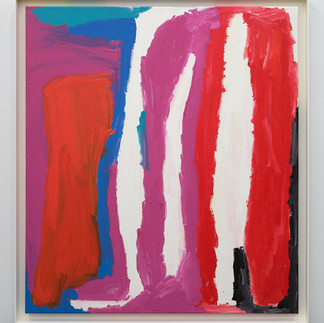


All images courtesy of the Karma gallery
Her work continues to resonate a decade later with this captivatingly curated exhibition titled 'a story place out to sea'. The basis for these paintings is a concept called "chorography", a subset of geography which maps very specific regions or districts, rather than contextualizing them within the wider world. These are profoundly expressionist images, to be sure - but not in the way that American and European abstractionists laid bare stormy emotional tumults on their canvases. Gabori was instead listening to the expressions of her land - you could say her surroundings spoke to her brush - and translated them into boldly realized representations of that land. (This 2022 Fondation Cartier presentation features 38 of her works.)
As for her joyful, unfettered use of color, it again is not beholden to any recent history of contemporary art; it is instead organically and enigmatically drawn from the memory of the land - even as the landscape evolved, devolved and changed over the years she was working.
The West, it could be said, is lamentably losing its visceral connection to its own land, vividly explicated in a recent article in The Guardian. Which is why the work of artists like Mirdidingkingathi Juwarnda Sally Gabori continues to resound so vibrantly and poignantly - as it reflects a yearning for a time and a feeling before rampant overdevelopment has ultimately left us so...disconnected.
(Parents: The Museum of Fine Arts Houston has this terrific page of activities and videos that can guide kids through at-home projects inspired by Aboriginal and other Indigenous arts.)

