
The Only Magazine for Children's Art
Jul 2, 2026
"Art can be so profound in this context."
Opening image: Takashi Murakami
Hospitals have long been faced with a challenging paradox: in order to maximize the safety of patients and staff, a clean and sterile atmosphere must be ideally maintained. Yet for those patients, that very same sterility does little to encourage the "positive attitude in the face of adversity", which is so often referenced as being necessary to the most expedient recovery.
In both Ancient Greece and Rome, healing the sick was regarded as a divine matter, and often involved music, poetry and other arts. Yet it wasn't until Florence Nightingale's landmark 1860 text 'Notes on Nursing' that at least some anecdotal evidence was first presented on the effectiveness of art-as-therapy.
Then in 1942, while British artist Adrian Hill was recovering from tuberculosis in a Midhurst, England sanatorium, he turned to art as a recovery strategy, and purposefully shared that notion with his fellow patients. Witnessing the positive results firsthand, he then definitively coined the term "art therapy" - and the contemporary concept of holistic healing was born.

Fast forward to the turn of the Millennium, a health scare endured by prominent NYC curator/gallerist Diane Brown sparked an idea that would ultimately become RxART. And for more than 25 years now her vital organization has been illuminating pediatric spaces with artworks created by some of the most eminent figures in the contemporary art world. One need only scan a list of just some of the completed projects to grasp the scope and significance of their work:
Jeff Koons at Advocate Children's Hospital in Illinois in 2010; Ed Ruscha at Children's Hospital of Los Angeles in 2017; Dan Colen at St. Mary's Healthcare System for Children in Queens, also in 2017; Takashi Murakami at Children's National Hospital in DC in 2022; Ann Craven at the SUNY Upstate Nappi Wellness Institute in Syracuse in 2023; Rashid Johnson at the University of Minnesota’s Masonic Institute for the Developing Brain in 2024; and most recently (2025), Mickalene Thomas' vividly captivating installation at NYC Health & Hospitals / South Brooklyn.
RxART has also created art products so utterly cool that even the best museums must surely be jealous: a Yayoi Kusama puzzle, a Derrick Adams tote bag, even Urs Fischer pajamas. A new coloring book is coming soon that will be co-edited by Julia Chiang and KAWS. (All products are available on their website.)
To get a little bit deeper on the story of RxART, we engaged founder Brown and the organization's new-ish director Katie Hollander in a delightfully enlightening conversation.
Above video: Shara Hughes at Phoenix Children's Hospital
What was the initial inspiration for launching RxART 26 years ago?
Diane Brown: My whole life was the art world, I had a gallery, I was working as a curator. Then I wound up having medical problems, and had to get a CT scan. There I was on a gurney in this sterile room with a needle hanging out of my arm - and I thought that I could try to escape [from that reality] by using my imagination. So I imagined a painting going across the ceiling, and I got completely involved in that vocabulary - then suddenly the test was over.
I later realized that anyone else in that situation who didn’t have my sort of imagination would need a little help getting there. So I started asking everyone in my circle - curators, artists, collectors - if they thought I could put museum quality art in hospitals; everyone thought I was crazy except for one person, and that was Aggie (Agnes) Gund (the late art collector, philanthropist and President Emerita of MoMA).
What made you end up focusing on pediatrics?
DB: That was a board decision. We only had a staff of two people, so we needed to just concentrate our efforts in one area.
We know a lot more about the therapeutic qualities of art now, whether it’s for kids or for seniors facing cognitive challenges. Did that factor into how you developed the RxART mission?
DB: Yes, and it has come a long way since we started.
Katie Hollander: Hospitals have always believed they should just be maintaining a clean and sterile environment, and that that was a sign of good care. But being in a sterile, brightly lit white space can feel intimidating.



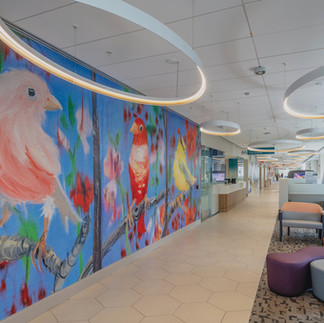


Dan Colen; Ann Craven; Kenny Scharf
How have the artists reacted to being involved with RxART?
DB: The artists love doing this. I’ve asked each one to be true to themselves, I didn’t want them to talk down to the kids. I want the finished work to genuinely reflect their art practice…as long as it isn’t something frightening.
Are the artists compensated?
DB: We pay a small honorarium for the artist, and then cover the costs of fabrication, travel and installation.
KH: There’s no cost to the hospital, we raise all the money for the projects. The artists actually love giving back to the community. These are long term installations, our projects have to be displayed for a minimum of five years. So for the artist it feels very fulfilling.
Hospital and healthcare staff must also appreciate that you are brightening their workplaces.
KH: Yes, there’s also a benefit to the hospital staff. They’re dealing with life and death on a daily basis, in an intense work environment - so we are trying to bring a little happiness to that environment. We did a project with Derrick Adams at Harlem Hospital; a doctor there said that he had seen Derrick’s work in a museum, and was so moved that his art was now being displayed in their emergency room.


RxART products
Have there been particular highlights over the years, certain artists you’ve worked with?
DB: People always ask me what has been my favorite project…and it’s always the one we’re working on now. But there was one… a Rob Pruitt CT scan machine that we installed at the Children’s Hospital of Orange County. He turned the scanner into [an artistic representation of] a life preserver. During the ribbon cutting a little nine-year-old girl who had to get regular CT scans said to me that she was always scared that the machine was going to eat her up. Then she remarked, “Now it’s a life preserver and it feels so fun!”
That’s such a wonderful story.
KH: What I find most inspiring is how hard the artists work for what is a nominal fee. Right now we’re working on a project with [Indigenous artist] Jeffrey Gibson in Colorado. He and his team are putting so much time and effort into it; and it’s really moving to know how much they want this to be rewarding for anyone who experiences it.
Can you quickly sum up why the work of RxART is so important?
DB: Because art makes the whole world bigger and more beautiful; and it can be so profound in this context.

Mickalene Thomas with her installation