
The Only Magazine for Children's Art
Jun 1, 2026
"I was standing on broken dishes with a brush taped to a stick..."
New York painter Julian Schnabel became very famous in the 1980s for his paintings in which he assembled fragments of broken plates on large scale canvases, creating a whole new textural style. They were regarded as provocative at the time, but they were also imbued with deep spirituality and meaning, conveying how one can often have a sense that we are sometimes living a fractured existence.
He later went on to become an award winning filmmaker, launching his concurrent career in 1996 with the critically acclaimed biopic 'Basquiat' - about the late, great painter of the title.
Fast forward to 2026, and Schnabel is still making important art. To wit, his new exhibition at New York's Pace Gallery titled 'Italy Through its Trees' (on view through August 14). He was first inspired by the breathtaking landscapes of the 'Bel Paese' (beautiful country, as it is sometimes called), when he traveled there in his 20s. Then while making a film in Rome in 2025, he at last decided to turn that inspiration into a series of new paintings.


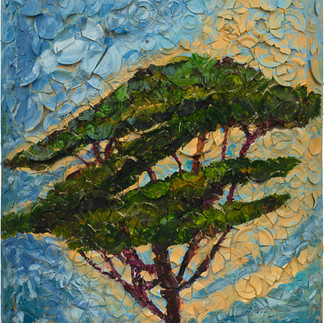


During the production, Schnabel happened to be staying in close proximity to the spectacular 17th Century Villa Borghese, which not only holds a breathtaking collection of Roman sculptures and Old Masters, but is also surrounded by the lush, rapturously beautiful Borghese Gardens. Those gardens just happen to be populated by the Pinus pinea, the Italian Stone Pine, which actually resembles a particularly artful looking, nature-made umbrella (May we suggest a Rihanna theme song for them?), which captivated the artist's considerable imagination.
So when filming was completed for 'In The Hand of Dante' (streaming on Netflix starting June 24), he retreated to the Tuscan seaside resort of Ansedonia, also home to a grove of Pinus pinea. There he set about capturing their unique beauty, painting "en plein air" (French for "in the open air") - which formed the basis for this captivating new series. Strikingly, he uses a background of broken plates for some, and paints over historic maps for others, both well-known and critically-acclaimed signatures of his. The latter creates the effect of the trees floating above the canvases.
“I’ve never made drawings for paintings before,” Schnabel explains. “Because of that, I painted the plate paintings in a different way, on the floor. Instead of putting down a dark ground, I gave them a ground of Naples yellow, then between the blue and the Naples yellow, I could deal with whatever the sky became, then the branches, in crimson and mineral violet."

The finished works somewhat recall the paintings of cherry and pine trees from the 17th Century Japanese Edo period, in regards to their vibrant stylization. Though for anyone who has visited Italy's most beloved region, the soul of Tuscany is immediately evident in the essential aesthetic. And perhaps giving new meaning to the term "throwing myself into my work", he literally inhabited the paintings during the creative process.
“I was literally standing on the paintings", he recalls. "Standing on a bunch of broken dishes with a brush taped to a stick and mixing the paint on the surface of the paintings, while standing on top of them. That was unusual for me to be doing.”
Of course, for Schnabel, nothing is ever quite as it seems on the surface - and so this new exhibit most certainly encourages quiet contemplation, with the Pace Gallery offering that the works "suggest a notion of how abstraction lurks within the visible world, as a possibility within forms."
Or as the artist himself so enigmatically puts it, "They are pictures of something, but not really pictures of trees."

All images are courtesy of the Pace gallery