
The Only Magazine for Children's Art
Nov 9, 2026
Your favorite chair was once just an idea.
Considering how design has such a profound effect on our lives every day, it's a bit odd that it is something that we rarely ever give much thought to, or have much conversation about. Mostly, we just take it for granted.
Yet every time we sit down in a chair that we chose because it appeals to our sense of style, but also provides significant ergonomic comfort; every time we pour coffee into our favorite coffee cup, or wine into our favorite wine glass and enjoy how it feels in our hand; or every time we turn on a lamp to illuminate a room but also find ourselves appreciating the way it looks on our end table...we are continuing a lifelong relationship with how the design of things shapes our day to day visual and practical existence.
No museum in America tells the story of design so comprehensively and thrillingly as New York's Cooper Hewitt, which is actually a member of the venerable Smithsonian group of cultural institutions. Located not in DC but in the stately Andrew Carnegie Mansion in NYC's Upper East Side neighborhood (just up the road from The Met and the Guggenheim), a 2014 renovation expanded its exhibition space to an impressive 17,000 square feet, which has allowed for much greater curatorial ambitions over the past decade.





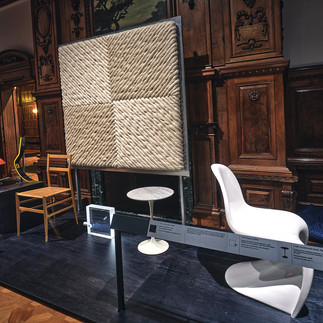
Making particularly good use of that space is a new and ongoing project titled 'Design Across Time: Exploring the Smithsonian’s Design Collection', which debuted this past summer. The concept is to rotate in and out thematic curations in a continuum, giving design lovers the opportunity to take in the scope of the museum's collection -which totals more than 215,00 objects - in a thoughtful, strikingly presented manner.
“Cooper Hewitt holds the nation’s design collection," explains director Maria Nicanor, "a public resource that belongs to all - and that, as is common across museums worldwide, is largely kept in storage."
So this undertaking is directly addressing the issue of having more items in their collection than can possibly be displayed at any given time, even within the substantially expanded space. And as generally happens with such excellently curated museums as the Cooper Hewitt, each presentation comes with a fascinating history lesson.
Indeed, a royal jewel cabinet dating to 1825/26, was actually gifted by King Charles X of France to King Francis I of Naples - and is revealing in its magnificence, as gifts between monarchs tended to also be acts of one-upmanship ("See how much more talented OUR craftsmen are than yours?") While retro-futuristic design objects from the 1960s and '70s - what are now iconic chairs, lamps, telephones - represent the more populist revolution of design that had taken over kitchens and living rooms across America during the time of a rising middle class, and, well...a growing desire to own things that boldly showed off one's good taste.
Fast forward to the 21 Century, and just as too much consumption and its attendant worrying effects on the environment were becoming a widespread concern, Stephen Burks' 2017 roping stool, included here, perfectly represented the new movement focused on repurposing that which would otherwise have made its way to a landfill. The recycling of materials is now firmly entrenched in contemporary design culture.
The exhibit is edifyingly built around several key design buzzwords - "Play, Tweak, Repeat, Transform, Simplify, Show Off" - which have formed a common basis of methodology, even as designers have often gone off in their own radical directions, conceptually. For young people, there is much to learn here about the balancing of creativity and practicality - something which is quite useful even when applied to matters of business.
Nicanor sees the project very much as a mission, one that the Cooper Hewitt is uniquely positioned to carry out.
“Expanding access for all to this rich repository of ideas - at a time when creativity and design can help us navigate uncertainty and complexity - is urgent, and inspired the idea to bring this selection into view for an extended period.”
(Parents: This recent YouTube video from ArtClass makes for a quick but fun introduction for kids to the history of design.)
