
The Only Magazine for Children's Art
Jun 17, 2026
Pace Gallery exhibits his captivating new 'Moon Room' series.
Artist David Hockney was born July 9, 1937 in Bradford, England, at the latter end of the Great Depression, and just two years before Britain would enter WWII. So the very idea that he would spend most of his adult life creating work that conveyed joy and hopefulness, even when hope seemed hard to come by, says so much about the essence of the person that he was.
Hockney passed away peacefully in his London home on June 11, 2026, with no specific cause of death yet given. (He experienced a stroke in 2012, and suffered from chronic respiratory problems.)
He achieved fame fairly early in his career, becoming a fixture of the British Pop Art movement and running with the Swinging Sixties London set, who were arguably the most notable trendsetters of their time. He also courageously came out at a time when being openly gay could actually have significant consequences. Working tirelessly until the end, he remarkably retained his cultural icon status over six decades, with his 1972 acrylic-on-canvas painting 'Portrait of an Artist (Pool with Two Figures)' selling for more than $90 million at Christie's New York in 2018, a new record at the time for a living artist.
His critically acclaimed exhibition 'A Year in Normandie and Some Other Thoughts About Painting' is showing currently at London's Serpentine Galleries, featuring his epic, yet distinctly serene and contemplative work of the same name - inspired by the famous Bayeaux Tapestry. He was, at 88 years old, still engaged, engaging, and enthusiastically doing press for the exhibit, which is on view through August 23. One imagines major museums are already planning career retrospective events for 2027.

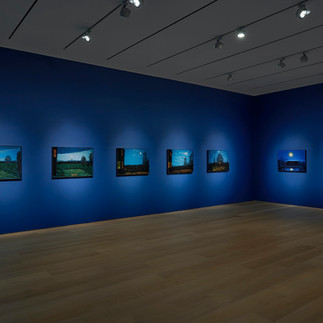

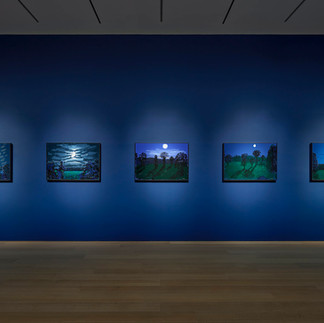


Yet his new exhibit 'Moon Room', on show at New York's Pace Gallery through August 14, provides an opportunity to viscerally connect with a particular aspect of his painterly soul. As with the "tapestry", this series was also inspired by his time spent in a peaceful corner of Normandy, France, at the outset of the pandemic in 2020.
What he experienced there was not uncommon during that time, when social isolation caused so many to suddenly notice things around them more clearly. He happened to observe a "supermoon", a phenomenon that occurs maybe three or four times annually, when the Moon is closest to the Earth - and was immediately captivated by it.
He recalled just before his passing, "We were just sitting outside the house, and we put all the lights off in the house to see the moonlight more clearly. The moon could then be seen to cast shadows of the trees on the grass, so with my backlit iPad I could draw it. This would have been virtually impossible without it."
The resulting images, debuted in 2024, are possessed of a kind fairytale-like quality; and the almost dreamlike way the scenery is lit by the moon recalls the surrealist visual deceptions that René Magritte would employ to trick the viewer. Though Hockney was most definitely capturing an unexpected moment of genuine reality.
He also quite cleverly observed that a "big moon" could not be photographed, since it is the actual source of light, and necessary details would end up being obscured. It had to be drawn.
“I was looking at the moon for quite awhile," he remembered, "and when you do that, you see this halo around it that you don’t see in photographs at all, because it’s too far. That’s an example of the way lenses push things away. In a lens view, it would be disappointingly small."
Rest in infinite peace, Mr. Hockney.
Note: David Hockney was a dog lover, as well - and painting his beloved dachshunds famously acted as therapy for him during a time of terrible loss and tragedy in the early 90s. Please see our tigernoodles story 'We Love Making Our Pets Into Art!' for more on how his dogs inspired him.
And should one wish to glimpse the next supermoon, it is predicted for November 24, 2026.

__________
To get to know David Hockney better in his own words, please check out this wonderful BBC interview with the artist himself, which was conducted ahead of his landmark 2025 exhibition at Paris' Fondation Louis Vuitton.