
The Only Magazine for Children's Art
Mar 9, 2026
Finding artistic inspiration in the world around us
Since we mostly all would agree that spending more time outside is better for kids than being inside staring at a screen, it's nothing less than urgent that parents and the education community take decisive steps to making that actually happen. After all, the trends are worrying, with the The Centers for Disease Control and Prevention reporting in 2024 that the average 8-10 year old spends about six hours a day immersed in some form of digital engagement. It certainly seems like too much.
Artist and educator Katherine Patiño Miranda responded to the situation by founding Creative Nature NYC in 2020, with the goal of cultivating youth creativity through direct interaction with nature. She draws on the influence of the likes of Vietnamese Zen master Thich Nhat Hanh and his notion of inter-being, as well as the Reggio Emilia Approach, and Brazilian education trailblazer Paulo Freire - with all encouraging giving children space to make their own explorations and discoveries.
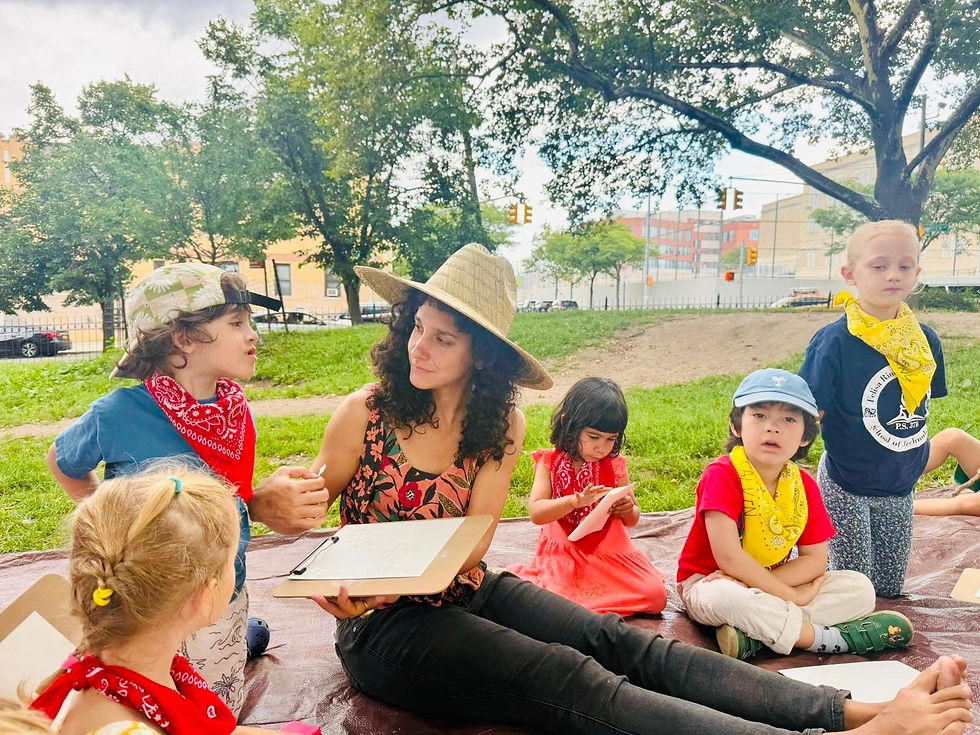
Creative Nature NYC invites children and families to explore art and ecology via hands-on outings and adventures in the city’s plentiful green spaces. They partner with public and private schools to offer unique after-school programs and workshops that combine nature attunement with the cultivation of creative curiosity and inquiry.
That Creative Nature's experiences take place in and around New York City of course means that not everyone has practical access. But we engaged Ms. Patiño Miranda in a discussion that we hoped would inspire ideas in parents and education professionals everywhere. (This is Part I of the interview - Part II will be published in the coming weeks.)
What was your mission in starting Creative Nature NYC?
"I wanted to open a space for children to wonder, to ask questions about nature, art, and their relationship with the world. In many ways, Creative Nature NYC began as an act of curiosity itself: How can we nurture artistic inquiry that helps dissolve the boundaries between humans and the natural world?
When we invite children to create with natural and recycled materials, to observe, to build, to invent, we’re not just making art, we’re building a new way of seeing. We’re asking: What if we stopped treating nature as something 'out there', and began to experience it as something we’re embedded in?
I believe that much of our environmental crisis comes from the illusion of separation - the idea that we are somehow outside of nature. Through artistic experimentation, we’re trying to offer children a lived experience of connection. When they sense that they’re part of a living system, care, empathy, and creativity naturally follow."
You were influenced by the Reggio Emilia Approach to learning. Can you explain a bit about that? What core principles did you take from it? And how can anyone apply those principles to their own children’s learning experience?
"What I love most about Reggio is that it sees children as protagonists or their own learning, not passive receivers of information. One idea that really influenced me is the notion of emergent curriculum. which simply means paying close attention to what children are interested in, and letting learning grow from there. Instead of sticking to a rigid plan, you follow their questions and discoveries, so the experience stays alive and meaningful.
Another part of Reggio that resonates with me is the idea that the environment is the third teacher. When a space - whether indoors or out in a green area - is organized, welcoming, and tilled with natural materials, it naturally invites exploration, conversation, and creativity. Kids engage differently when their surroundings support their curiosity.
And then there's the belief that children express themselves in many “languages” - through movement, drawing, storytelling, building, sound, and even moments of silence. When we honor all those forms of expression. we give children real agency and a sense of dignity in how they learn and communicate.
Creative Nature NYC grew from that spirit - a dream, maybe even a gentle rebellion - to imagine what education could look like if we trusted children's natural intelligence and gave them the space and freedom to explore.”
How is that "rebellion" evolving now, and where do you see it going in the next five years or so?
"We’re now experimenting with what I call a living curriculum: one that truly emerges from the dialogue between children, teachers, and the ecosystem itself. Sometimes that means spending a morning following an ant trail, or creating stories about a fallen leaf - and from those small observations, big ideas emerge about connection, transformation, or time.
I think any parent can encourage this spirit at home. It starts with curiosity - with observing, listening, and being genuinely interested in what a child notices...not rushing to teach or explain. It’s about slowing down enough to let wonder lead."

Is connecting children with nature even more urgent in these tech-obsessed times?
"That’s such an important question - and I think we need to be careful with 'green' slogans. It's easy for everything, even our relationship with nature, to become polarized: 'tech versus nature, screens versus trees'. But for me, the real question is deeper: What is nature, really?
I believe it is all about reconnecting with our own creative nature, that inner sense of curiosity, imagination, and wonder that makes us human. [Iconic Swiss Expressionist painter] Paul Klee once asked, “What is the nature of nature?”; and I often think about that question when I see children creating.
I’m also very inspired by Thich Nhat Hanh, whose teachings remind us that we are not separate from the world around us. His influence on Creative Nature NYC has perhaps been even deeper than Reggio Emilia’s.
Can we devise a healthy balance for kids between nature and technology?
Of course, I believe that every child deserves the daily right to unplug, to experience quiet, to feel textures and time in real space. But at the same time, I’m not against technology. I think we also need to ask: What is technology? How can we use it consciously?
As some philosophers have said, our gift isn’t our physical strength, but our collective imagination - the ability to create, to invent, to believe in shared stories. That’s what I want to nurture through Creative Nature NYC: a space where children can imagine better possible futures together, where art and ecology merge into acts of imagination, care, and hope.
