
The Only Magazine for Children's Art
Oct 27, 2026
"I regard the picture as an ecosystem."
When Charley Harper passed away in 2007, he left behind a legacy of arguably the most expansive modernist depiction of wildlife, including 10 inimitable paintings commissioned by the U.S. National Park Service during the 1970s and 80s. As a proud Cincinnatian, it only makes sense then that his home city should at last gather it all into an appropriately breathtaking career retrospective.
And so it was that 'The Art of Charley Harper: Creatures Wild and Tame' opened on October 16 at the Cincinnati Art Museum, to significant excitement. What made Harper's art especially singular was that wildlife tended to be stuck within the boundaries of its most traditional depictions in art and photography, with an emphasis on representation and tradition. His work, instead, brought out so much of the actual playfulness that has long endeared us to our beautiful friends in the wild.
Brett Harper, Charley's son and also the director of his father's posthumous, namesake studio, makes the point that visitors "can look forward to a special historic treat", as the aforementioned National Park Service paintings "were only on public display for a short time in Washington, D.C. in the 90s."




(Click on pictures to enlarge)
Charley defined his own style as "minimal realism", an art movement that, amusingly, literally only he occupied. Yet there was a kind of "magical realism" about his images as well, imbuing his birds and tigers and deer with an animated presence that was whimsical, fancifully enchanting and completely athwart all that solemnly earnest nature photography and hyper-commercialized Hollywood anthropomorphism.
"When I look at a wildlife or nature subject," he revealed, "I see exciting shapes, color combinations, patterns, textures, fascinating behavior and endless possibilities for making interesting pictures. I regard the picture as an ecosystem in which all the elements are interrelated, interdependent, and perfectly balanced. And herein lies the lure of the painting: in a world of chaos, the picture is one small rectangle in which the artist can create an ordered universe."
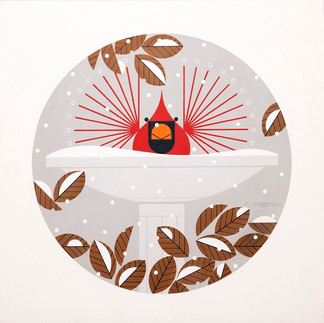
Take his 1976 'Glacier Bay, Alaska' for instance, which fits eagles, butterflies and the gargantuan tail of a diving whale into the same frame - an impossible tableau in reality, surely, but one which allows imagination to take priority above all. Other highlights include the amusing 1975 'Raccpack', a slightly ominous assemblage of raccoons whose bodies are clustered together to form a most unexpected totem pole, of sorts; 1986's 'B-r-r-r-r-rdbath', with a snowy cardinal looking fully stylish and flamboyant enough to have been plucked from the pages of a high fashion magazine.
His 'Impala in the Grass (Daytime and Nighttime)' is arguably his most iconic work, with the graceful creatures in full "stare" mode, summing up the intentions of onlookers - whether human or wild - as they are wont to do in real life. Harper somehow manages to make one of nature's sleekest ever creations even sleeker. Literally in every work featured in the exhibit, you can sense his exuberant affection for all of his subjects.
Added bonus: visitors are also treated to behind-the-scenes insights into his working process.
"The exhibition celebrates everything we love about Charley Harper," enthuses Julie Aronson, the museum's curator of American paintings, sculpture and drawings, promising that it offers "fresh insight into his joyful artistry."
'The Art of Charley Harper: Creatures Wild and Tame' will be on view at the Cincinnati Art Museum through March 7, 2027.
