
The Only Magazine for Children's Art
Jul 29, 2026
"In Brazil, wild animals frequently enter human spaces."
A particular favorite artist of ours, Alexis Rockman, has long painted what are often unsettling scenes of undersea life, in which he assigns to his subjects exaggerated, sometimes frightening characteristics - surely to remind us that the oceans we have been such irresponsible stewards of are rife with mystery and, of course, sometimes unimaginable danger.
Brazilian artist Ana Elisa Egreja similarly conjures fantastical depictions of nature - but instead brings them right indoors. To wit, her current exhibition at San Francisco's Jessica Silverman gallery - her first ever US solo show - presents 15 vibrantly enigmatic new watercolors in which wildlife appear to have basically taken over the rooms of the house.
Fittingly titled 'The Flight of Color' (on view though September 3), the parrots populating the scenes, especially, seem as if possibly styled by Versace; and a lounging leopard looks straight out of a Roberto Cavalli ad. The artist herself describes the scenes depicted as "improbable but not impossible" - or as we might put it, not so much surreal as head-tiltingly unexpected. Yet there is a kind of formality that underlies each, the result of her long-standing appreciation of 18th Century Dutch still life painting, with its vivid color palettes and meticulous attention to detail.
Though each image is provocative in its own way, we are especially drawn to the extravagantly titled 'Pink Table with Chinoiserie and Roseate Spoonbills', with the also-pink birds of the title having a presence that almost feels prehistoric, as they stalk an assemblage of curious, not-easily-identified foodstuffs.
As the exhibition opened, we were lucky enough to have the opportunity to engage Ms. Egreja on the ideas and inspirations behind these striking new paintings.
(Note: The Jessica Silverman gallery will be hosting a free "Family Art Day" at 10:30am on August 29, featuring coloring sheets of Ana Elisa Egreja's work for the little ones.)
(Parents: This enlightening YouTube video can give kids practical insights into Ana Elisa's artistic process, and offer tips on how to be inspired to just paint the things they see around them in their own home.)

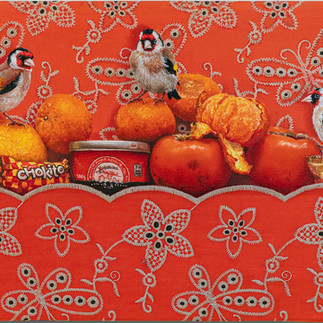


You depict wild animals and birds in unusual domestic settings - is there a reason no humans are allowed in those scenes?
I think the human presence is there, but indirectly. The houses, furniture, and objects are all traces of the people who inhabit them. For me, the house can be seen as a metonym for its inhabitants. The animals introduce a sense of unpredictability and freedom into these carefully ordered spaces. They transform ordinary domestic interiors into places where reality and imagination coexist. I like that tension between the familiar and the impossible.
Food, furniture, birds, cats, are all done up in enthrallingly exaggerated colors. Are you tempting the viewer into a reality that is more visually vivid than their everyday existence?
Yes, in a way. I’m interested in creating a world that feels more intense, more utopian and more optimistic than everyday reality. Color is never merely descriptive in my work. It creates emotion, atmosphere, and rhythm. Sometimes I begin with a color palette before I even know exactly what the painting will contain. The colors invite the viewer into a space that feels recognizable but doesn’t actually exist.

One might observe that you’ve taken the formality of 18th Century Northern European still lifes, and introduced it to the flamboyance of 20th Century fashion magazine styling, David LaChapelle, etc. Can you reveal the specific inspirations for these new paintings?
Dutch still-life painting has certainly been one of my longest-standing references, especially its extraordinary attention to detail and its celebration of everyday life. At the same time, I don’t try to recreate historical painting. I’m interested in bringing those traditions into dialogue with contemporary visual culture - with advertising, fashion photography, interior design, cinema, and Brazilian visual culture.
I also draw inspiration from magical realism, where the extraordinary can quietly inhabit the ordinary. My goal isn’t to quote specific images, but to create paintings where different visual histories coexist naturally.
Humanity perpetually exclaims its adoration of nature, whilst we are continually and dangerously degrading it. With this exhibition, are you trying to imagine a new way of reckoning that relationship?
I wouldn’t say the exhibition offers a solution or a proposal for a problem. Rather, it imagines a world where that separation between nature and domestic life no longer exists. In Brazil, wild animals frequently enter human spaces - not only in the Amazon, but across the entire country. As climate change and ecological imbalance intensify, these encounters are becoming more common.
When I paint these animals, which are so symbolic of Brazil, I’m interested in the boundary between beauty and tragedy. And I never forget that the final result is a painting. As important as the narrative may be, I’m always trying to create harmonious compositions through the intrinsic elements of painting itself: color, form, and the awareness of its two-dimensional surface. The image has to succeed as a painting before anything else.
