
The Only Magazine for Children's Art
May 4, 2026
The American Museum of Natural History's 'Invisible Worlds' is an immersion in the unseen natural world.
Human beings - especially Americans - are arguably perpetually fascinated by that which is the biggest and most spectacular.
We gasp at towering skyscrapers, awe at gargantuan elephants and 75-ft. blue whales, drive hulking SUVs to the grocery store that seem to barely fit in a reasonable sized parking space - and then, well...there's Shaq, who at 7' 1" and 325 pounds is one of our most enduringly beloved American icons...even though we're still not quite sure how he even fits behind the wheel of a car.
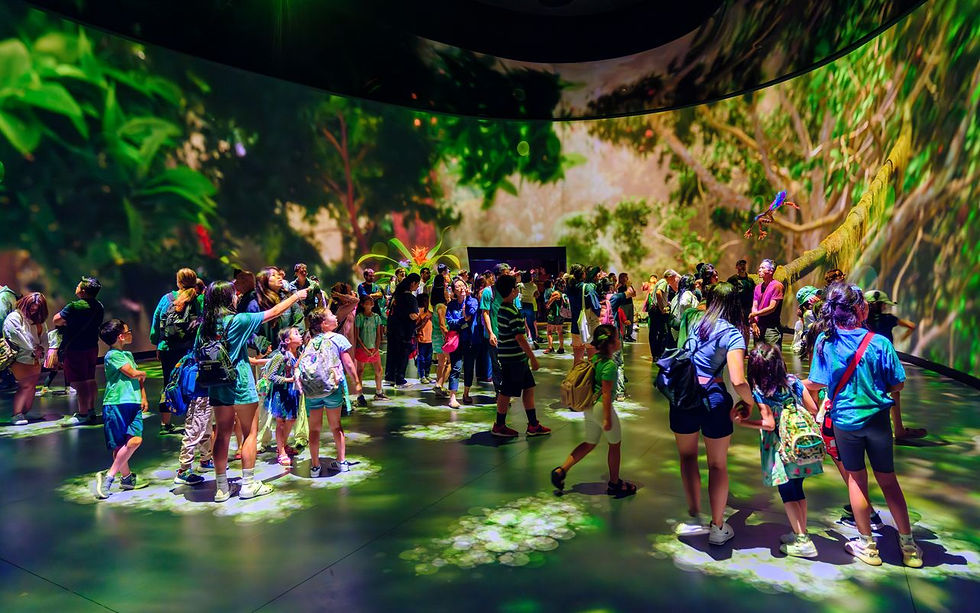
What we don't usually stop to think about are all the living things that are too small for the human eye to detect - yet are everywhere all around us every day. No surprise, the always challenging American Museum of Natural History in New York City decided to do something about that. Located on the third floor of the new-ish Gilder Center - which debuted in 2023 to significant acclaim - the ongoing exhibition 'Invisible Worlds' recreates microscopic universes, from the Brazilian rainforest, to the deepest depths of the oceans, to the mysteries of the human brain itself, and thrillingly projects them to create a resplendently sensational 360 immersive experience.
As educational as it is eye-popping, the exhibit consists of a mirrored ceiling, 23-ft.-high walls, and an interactive floor that responds to visitors' movements. If it sounds like quite a production, do keep in mind that such technical razzle-dazzle has come to be expected in our new digital age, as young people have been essentially raised on technology. 'Invisible Worlds' just manages to take it all to dizzying new visual and educational heights.
It plays to a now firmly entrenched trend, arguably launched by the debut of the digital-art-driven Artechouse (which first opened in DC in 2017, and now has locations in NYC and Houston, as well), which was then followed by countless wildly successful touring immersive exhibits based on artworks by the likes of Van Gogh, Klimt, etc.
'Invisible Worlds' producer Vivian Trakinski - who also serves as AMNH's director of science visualization, explained to the New York Times the need to "keep pace with popular culture," adding that, "[Young people] are engaging with digital media across multiple platforms, and we want to meet them where they live.”
The ultimate "mission", if you will, is to bring visitors closer to the vast interconnectedness of virtually everything - reminding us that we share a planet with creatures equally vital to our ecosystem, that are yet still too small to be detected by the gaze of the human eye. And as we all face serious challenges to the environmental maintenance of our shared planet Earth (especially when it come to our precious oceans), such an exhibition as this can genuinely foster greater empathy for how continued indifference to this worrying reality can negatively impact all living things, whatever their size.
Note: For those without easy access to the American Museum of Natural History, YouTuber Pinay New Yorker made this engaging 18-minute video tour of the 'Invisible Worlds' exhibit.
Should you be lucky enough to be able to visit in person, do make sure to also check out the equally new-ish Davis Family Butterfly Vivarium, where it's possible to directly interact with some of the planet's most beautiful - and kid-friendly - insect life.